
Is 800 VDC a Trojan Horse?
What if 800 VDC is a Trojan horse? The industry is enthusiastically embracing 800 VDC as the next evolution in data center electrical distribution, citing efficiency, reduced copper requirements, and the ability to support increasingly dense AI computing. The engineering arguments are compelling, but the long-term economic implications deserve considerably more scrutiny.
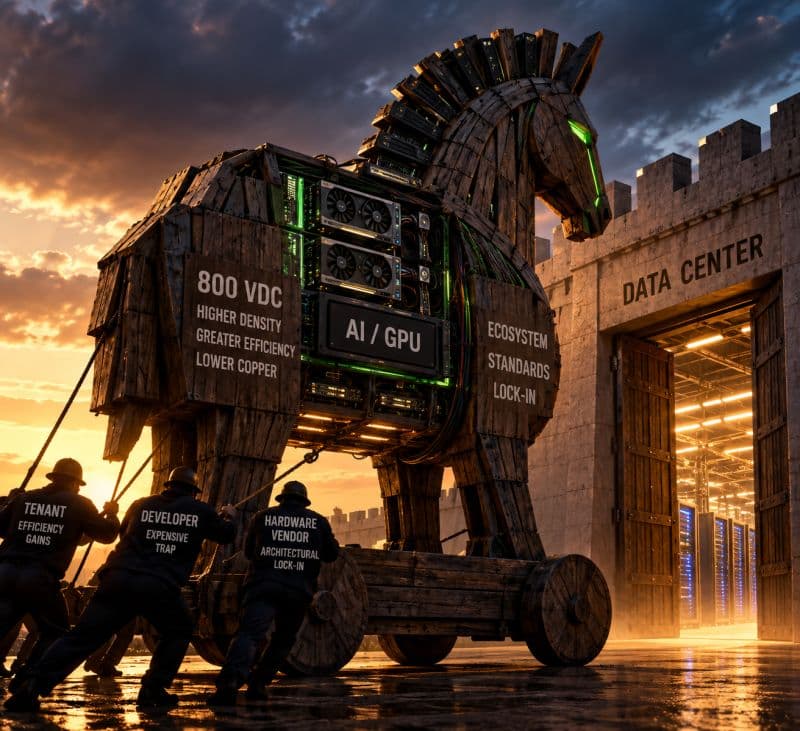
For decades, data centers have maintained relative independence between computing technology and the infrastructure supporting it, allowing successive generations of equipment, workloads, and tenants to occupy the same facility without fundamentally replacing its electrical distribution. Native 800 VDC potentially compromises that independence by embedding the requirements of a computing architecture with a three-to-five-year economic lifecycle into infrastructure expected to remain productive for twenty or thirty years.
For hyperscalers controlling their computing roadmaps, that may be a rational optimization. For merchant developers, it could be an extraordinarily expensive trap. They’re potentially financing long-lived infrastructure around a single tenant’s computing requirements, surrendering the flexibility that underpins future leasing opportunities and residual asset value.
The tenant realizes the efficiency gains, the computing hardware vendor gains architectural lock-in, and the developer inherits the technological dependency, conversion costs, and risk of obsolescence. What appears to be a competitive advantage at commissioning could become a material liability at lease expiration.
The Trojan horse isn’t 800 volts of direct current. It’s the possibility that merchant developers are financing decades of architectural dependency to optimize someone else’s rapidly depreciating computing platform. And when that architecture changes, who is left holding the asset?